



The war iran Wants the World to Feel
Some wars are fought for quick victories.
Others are designed to grind opponents down slowly — economically, politically, and psychologically.
What appears to be unfolding in the Middle east increasingly looks like the second kind.
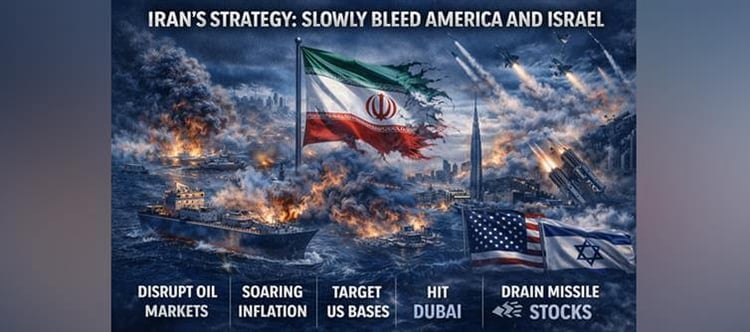
Rather than seeking a decisive battlefield win, iran seems to be pursuing a strategy built on endurance and disruption: stretch the conflict out, widen its economic impact, and force its opponents into a costly and prolonged confrontation.
It’s not just about missiles and airstrikes.
It’s about pressure — applied across energy markets, military bases, and global economies.
1. Turning Energy Markets Into a Battlefield
One of the most powerful levers iran holds isn’t military — it’s geographic.
The country sits near the Strait of Hormuz, a narrow channel through which roughly a fifth of the world’s oil supply passes.
Even a limited disruption in that corridor can send shockwaves through global markets.
Shipping delays, tanker risks, and insurance spikes can quickly translate into higher oil prices.
In other words, a regional war can instantly become a global economic problem.
2. Inflation as a Weapon
Energy shocks don’t stay confined to the oil market.
When oil and gas prices surge, the ripple effects spread everywhere: transport costs rise, manufacturing becomes more expensive, and food prices often follow.
For countries already battling inflation, a sustained energy spike can reopen economic wounds that governments have only recently begun to close.
In that sense, the battlefield extends far beyond the Middle East.
It reaches into the wallets of consumers around the world.
3. Pressure on U.S. Military Infrastructure
Another dimension of the conflict involves targeting regional military infrastructure.
The Middle east hosts numerous U.S. installations designed to project power and maintain security across the region.
Strikes or threats against these bases create both military and political pressure.
Even limited attacks can force costly defensive measures, disrupt operations, and heighten tensions across the region.
For Washington, protecting those installations becomes a constant strategic challenge.
4. Economic Hubs as Strategic Targets
Modern conflicts increasingly target economic centers rather than purely military sites.
Cities such as Dubai represent major global financial and logistics hubs.
Any threat to such locations instantly grabs international attention.
Even if major damage never occurs, the mere risk can rattle markets, drive up insurance costs, and trigger investor anxiety.
Economic disruption, after all, can sometimes achieve what military strikes cannot.
5. Draining Defensive Systems
Missile defense systems are extraordinarily expensive.
Interceptors designed to shoot down incoming rockets or drones can cost hundreds of thousands — sometimes millions — of dollars per launch.
When adversaries deploy large numbers of relatively cheaper projectiles, the economics of defense quickly become challenging.
Sustained attacks can force defenders to burn through stockpiles and allocate significant resources just to maintain protection.
In a long conflict, that imbalance can become strategically significant.
6. The Strategy of Time
Perhaps the most important element of Iran’s approach is time.
Rather than seeking a swift, decisive confrontation, the apparent goal is to extend the conflict.
A long war increases economic pressure, strains military resources, and raises political stakes for all sides involved.
Over time, public opinion, market reactions, and international diplomacy begin to shape the battlefield just as much as military operations.
7. The Risk of Underestimation
Conflicts often escalate because one side misjudges the other’s resilience or strategy.
Military superiority does not always translate into quick victories.
History is filled with examples where conflicts expected to last weeks stretched into years.
If this confrontation follows that pattern, it could evolve from a regional clash into a prolonged geopolitical struggle with global consequences.
The Bottom Line
Wars in the modern era are rarely confined to the battlefield.
They spill into financial markets, energy supplies, and global politics.
If Iran’s strategy is indeed built around endurance and disruption, the goal may not be immediate victory.
It may be something more gradual — forcing opponents to fight a longer, more expensive, and more complicated conflict.
And in wars of attrition, the outcome often depends less on who strikes first…
and more on who can endure the longest.
 click and follow Indiaherald WhatsApp channel