


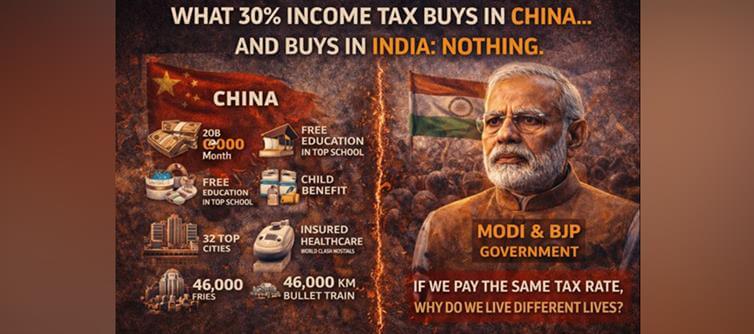

Paying 30% income tax is supposed to mean something. It’s not charity—it’s a contract. Citizens surrender a large chunk of their earnings in exchange for security, infrastructure, education, healthcare, and dignity.
In China, that contract—authoritarian as the system may be—at least delivers tangible outcomes. In India, under Narendra Modi and the Bharatiya Janata Party, the same tax feels less like a contract and more like a penalty for being productive.
1. Lose Your job in China, the State Steps In.
In China, job loss triggers state support—monthly unemployment assistance that cushions the fall. The system doesn’t moralise poverty; it mitigates it. In india, job loss means silence. No safety net. No dignity. Just “adjust.”
2. education Isn’t a business There. Here, It’s a Racket.
China invests heavily in public education, including top-tier schools. In india, quality education is largely privatised. If you want decent outcomes, you pay—often more than your annual tax bill. The poor are stuck. The middle class bleeds.
3. Children Are a Responsibility, Not a Burden.
China incentivises families with direct child benefits. india offers slogans. If children are the future, why does the state outsource their upbringing costs to parents already crushed by inflation and taxes?
4. Healthcare That Actually Works.
China’s healthcare system—state-backed and insurance-driven—delivers access to world-class hospitals for ordinary citizens. In india, public hospitals are overwhelmed, and private hospitals are unaffordable. Illness here isn’t a health issue—it’s a financial catastrophe.
5. Infrastructure You Can See, Touch, Use.
China didn’t build prestige projects for headlines—it built cities, rail, logistics, and connectivity. Tens of thousands of kilometres of high-speed rail didn’t appear by accident. In india, infrastructure announcements outpace delivery, and basic urban services remain unreliable.
6. Taxes There Buy Outcomes. Taxes Here Buy Optics.
In China, high taxes translate into visible public goods. In india, high taxes coexist with polluted air, unsafe water, power cuts, collapsing schools, and hospital queues. The citizen pays twice—once to the government, once to private providers.
7. Welfare vs Freebies: Know the Difference.
China’s welfare is structural—employment support, healthcare, and education. India’s is electoral—free rations, temporary cash, headline-friendly schemes. One builds capacity. The other builds dependency.
8. The Middle Class Is India’s ATM.
India’s salaried class funds the system but gets the least in return. No social security. No reliable services. No accountability. Yet they’re told to be “nationalistic” while being financially milked.
Final Word
This isn’t about praising China’s political system. It’s about asking a simple question:
If india wants China-level taxes, why does it deliver third-world services?
A government that taxes like a developed nation but governs like a struggling one is not ambitious—it’s dishonest.
Until taxes translate into water you can drink, air you can breathe, schools you can trust, and hospitals you can afford, the indian taxpayer is not a citizen—just a revenue source.
 click and follow Indiaherald WhatsApp channel