



Party Balloons Turned Into a Bomb: How a Cheap Scam Nearly Became a Mass-Casualty Event
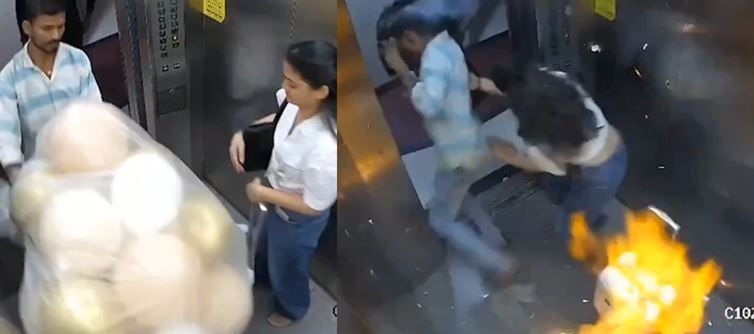
It took seconds. An elevator ride. A bunch of balloons. And suddenly—fire.
In a chilling incident, a dozen balloons being delivered to an apartment burst into flames inside a lift, narrowly avoiding a catastrophe. No chemicals. No accelerants. Just balloons. The kind we trust around children, birthdays, and celebrations. What went wrong wasn’t bad luck—it was bad science mixed with worse regulation.
What actually happened — the science nobody tells you
1) Hydrogen is not “just another gas.”
Hydrogen is extremely flammable. It doesn’t need a big flame—a tiny spark is enough. Balloons filled with hydrogen constantly leak microscopic amounts of gas.
2) Elevators are spark-friendly spaces
Lifts are packed with electronic relays, motors, switches, and static electricity from friction. One invisible spark + leaked hydrogen = instant ignition.
3) Why does it explode so violently
Hydrogen burns fast and hot. When multiple balloons ignite together, the fireball multiplies in milliseconds—turning a confined space into a pressure cooker.
4) Why do people unknowingly buy hydrogen balloons
Because most of them think they’re buying helium. Vendors often substitute hydrogen—it’s significantly cheaper and easier to source. The buyer has no clue.
5) This isn’t ignorance. It’s deception.
Helium is inert and safe. Hydrogen is a fire hazard. Selling one as the other isn’t a mistake—it’s a scam with lethal consequences.
The terrifying part nobody wants to say out loud
6) This could have killed many people
If this elevator had been full of children, elderly, pregnant women—this wouldn’t be a “scare.” It would be a national tragedy.
7) This can absolutely be weaponised
A bag of hydrogen balloons in a confined public space—lift, metro, mall—can create panic, burns, and stampedes. That’s not hypothetical. That’s physics.
8) This is the first viral case—probably not the first incident
We’re seeing it now because someone filmed it. How many near-misses never make the news?
The most important question: how can a layman tell the difference?
9) You mostly can’t—by sight alone
Hydrogen and helium balloons look identical. That’s the danger.
10) Practical red flags to spot safer vendors
Ask explicitly if the gas is helium—and get it written on the bill
Avoid roadside sellers using metal cylinders with no labels
Reputable vendors use branded, labelled helium cylinders
If the price feels too cheap, it probably is
Large events should demand gas certification
What authorities MUST do—now?
11) Mandatory labelling and licensing
Gas cylinders for balloons must be labelled and regulated like LPG. Period.
12) criminal liability, not fines
Selling hydrogen as helium should be treated as reckless endangerment, not a petty offence.
13) Public awareness campaigns
People need to know this before the next celebration turns fatal.
The bottom line
This wasn’t a freak accident.
It was a system failure—of regulation, enforcement, and awareness.
Balloons should bring joy, not fireballs.
If this doesn’t trigger urgent investigation and strict rules, the next explosion won’t be lucky enough to go viral before it kills.
Cheap shortcuts + ignorance + confined spaces = disaster.
 click and follow Indiaherald WhatsApp channel