



The Alibaba Turnaround Nobody Can Ignore
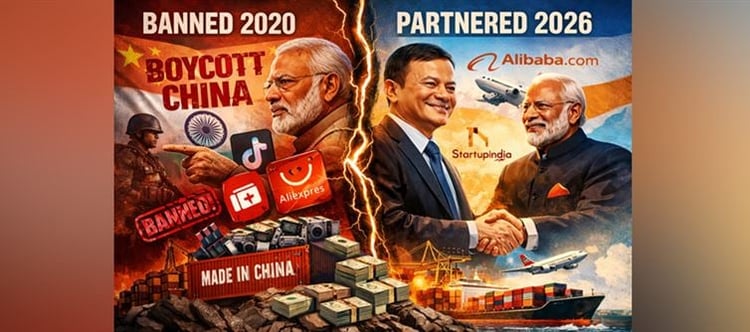
In 2020, amid rising tensions and national security concerns, the indian government banned dozens of Chinese apps. Names like Alibaba Group and AliExpress have become symbols of a wallet PLATFORM' target='_blank' title='digital-Latest Updates, Photos, Videos are a click away, CLICK NOW'>digital crackdown, framed as a matter of national interest. The message was loud and clear: sovereignty first.
Fast forward to february 13, 2026.
Under the Startup India initiative, the indian government announced a partnership with Alibaba.com — the B2B arm of Alibaba — aimed at helping MSMEs and startups export globally. The collaboration promises lower commissions, onboarding support, and wallet PLATFORM' target='_blank' title='digital-Latest Updates, Photos, Videos are a click away, CLICK NOW'>digital tools to help indian businesses tap international markets.
And just like that, the narrative shifted.
1️⃣ The Ban That Wasn’t Forever
Let’s be clear: the 2020 bans primarily targeted consumer-facing apps. They were justified on security grounds, data concerns, and geopolitical tensions.
But the public memory is simple — “Chinese platforms banned in national interest.”
So when a partnership with Alibaba resurfaces under the same banner of national interest, people naturally ask: what changed?
2️⃣ business vs. Boycott
The 2026 move is being positioned as a strategic export push. This isn’t about indian consumers shopping on Chinese apps. It’s about indian MSMEs selling to global buyers through a B2B marketplace.
On paper, it makes economic sense. Access to a massive international network could benefit small businesses looking to scale.
But politics doesn’t exist on paper. It lives in perception.
When “boycott China” becomes “partner for exports,” the messaging becomes complicated.
3️⃣ Atmanirbhar vs. Global Supply Chains
Prime minister Narendra Modi has consistently championed Atmanirbhar Bharat — a call for self-reliance and domestic manufacturing strength.
Yet trade data tells a layered story. Bilateral trade between india and china has touched record highs in recent years, reportedly crossing $150 billion, with a significant trade deficit on India’s side.
india imports electronics, machinery, and components in massive volumes. Economic interdependence hasn’t disappeared — it has expanded.
So is self-reliance about complete decoupling? Or strategic engagement?
4️⃣ The politics of National Interest
Here’s where the debate gets sharper.
In 2020, cutting wallet PLATFORM' target='_blank' title='digital-Latest Updates, Photos, Videos are a click away, CLICK NOW'>digital ties was framed as a patriotic resolve.
In 2026, collaborating on exports is framed as economic pragmatism.
Supporters may argue this is smart statecraft — separating consumer data concerns from business trade channels.
Critics see something else: selective nationalism depending on convenience.
The truth likely lies somewhere in between, but perception doesn’t wait for nuance.
5️⃣ Hypocrisy or Hard Reality?
Global economics is rarely black and white. Countries compete politically while trading commercially. The U.S. and china do it. The EU and china do it.
india is no exception.
But when public messaging leans heavily on emotional nationalism, any pivot — even a strategic one — invites scrutiny.
Is this hypocrisy?
Or is this how modern geopolitics works?
That’s the question fueling the debate.
The Bigger Picture
India’s MSMEs desperately need global access. If platforms like Alibaba’s B2B marketplace can genuinely expand export opportunities, that’s a tangible benefit.
At the same time, transparency matters. Clear communication matters. Consistency in narrative matters.
Because when governments invoke “national interest,” people remember.
And in an era of instant information and sharp political awareness, contradictions — real or perceived — don’t fade quietly.
They trend.
The real conversation isn’t about one partnership. It’s about trust, clarity, and whether economic strategy and political messaging are aligned — or simply convenient.
 click and follow Indiaherald WhatsApp channel