
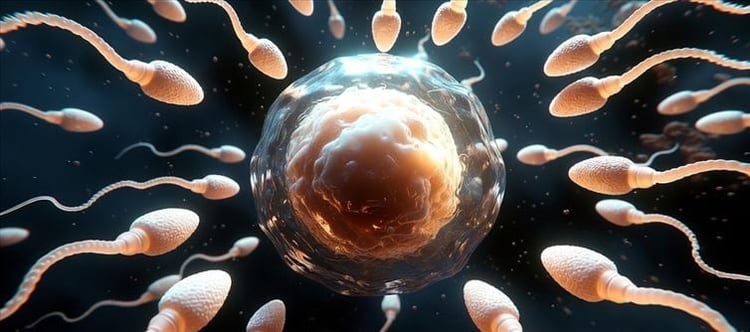


For decades, most people grew up believing the same simple story about reproduction: millions of sperm race toward the egg, and the fastest, strongest one wins. End of story. But a fascinating study from researchers in sweden has challenged that entire narrative — and the implications are far more mind-blowing than most people realize.
According to the research, the egg may not be a passive participant at all. Instead, it appears capable of chemically influencing which sperm gets the best chance of fertilization. In other words, even if a sperm arrives first, the egg can still “ignore” it and favor another candidate instead. That completely changes the traditional idea that reproduction is just a brutal speed competition.
Scientists found that follicular fluid — the substance surrounding the egg — can actually attract some sperm more strongly than others. Even more surprising, the sperm that an egg responds to most positively may not always belong to the male partner who appears genetically “ideal” on paper. Biology, it turns out, is playing a far more complex and selective game behind the scenes.
This discovery has sparked huge conversations in the scientific world because it suggests female reproductive biology may have a hidden filtering mechanism designed to increase genetic compatibility. Nature may be quietly evaluating combinations at a microscopic level long before a pregnancy even begins.
What makes this study so powerful is that it destroys the outdated image of the egg as merely waiting to be “conquered.” Instead, reproduction looks increasingly like a two-way biological negotiation, where selection happens on both sides.
The deeper message here is astonishing: human biology is far more intelligent, selective, and mysterious than we ever imagined. The race to fertilization may not simply be about speed or strength anymore — it may also be about compatibility, chemistry, and invisible biological choice.
 click and follow Indiaherald WhatsApp channel