
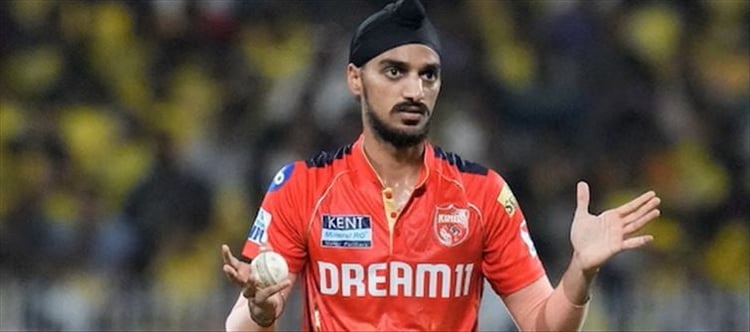


Arshdeep Singh opened the 3rd T20I at Trent Bridge with a maiden over to Phil Salt — six balls, zero runs — in a format where maiden overs are rarer than centuries. The left-armer's controlled aggression silenced England's most dangerous opener and set the tone for India's bowling attack, according to Cricbuzz and ESPNcricinfo coverage of the match.
Six balls. Six zeroes. One of the most feared power-hitters in world cricket, standing at the crease in his own backyard, unable to put bat on ball with intent. That is not a riddle — that is Arshdeep Singh at Trent Bridge, opening the 3rd T20I against England with a maiden over to Phil Salt that felt less like cricket and more like a public dressing-down.
In T20I cricket, maiden overs are unicorns. The format was built to destroy them. Batters swing from ball one, fields are up, and bowlers are taught to accept economy rates that would have horrified their predecessors. And yet there was Arshdeep — 0, 0, 0, 0, 0, 0 — as if the format's rulebook simply did not apply to him.
The numbers alone are startling enough. But the context is what elevates this from a statistical curiosity to a genuine tactical masterclass. Phil Salt is not some tail-ender groping at the new ball. He is, by most reckonings, the most destructive T20I opener on the planet — a man who averages north of 30 at a strike rate that makes seasoned bowlers reconsider their career choices. And he was in Nottingham, on English soil, with English conditions he has known since childhood. If anyone should have been comfortable facing a left-arm seamer under overcast skies, it was Salt.
He was not comfortable. Not even close.
Inside Talk
The chatter in cricketing circles is pointed and, for Indian fans, deeply satisfying. The talk among analysts tracking the series is that Arshdeep has figured out something about English conditions that most visiting seamers never do — the angle. A left-armer bowling from around the wicket into the right-hander's fourth-stump channel, with the ball shaping away into the Nottingham breeze, creates an angle that is geometrically almost impossible to attack without risk. Salt, who usually backs himself to swing through the line regardless, was left shouldering arms and nudging defensively. The industry read, as one former England seamer put it on social media, is that Arshdeep "made Salt look ordinary, which is the hardest thing in T20 cricket right now."
(This reflects expert and social media commentary, not confirmed private communications.)
What makes this even more telling is the recent memory. In the 2nd T20I, Arshdeep conceded 40 runs in four overs — a brutal evening that had pundits questioning whether India's death-overs insurance policy was expiring. The internet was not kind. Memes flowed. Questions were asked about his place in the XI.
And then, 48 hours later, the same bowler walked out at Trent Bridge and served, as Sony Sports Network memorably put it, "bagels."
The Anatomy of a T20I Maiden
Let us dissect what actually happened, because the scorecard does not capture the craft. Arshdeep's first ball pitched on a good length just outside off, seaming away fractionally. Salt left it. The second was fuller, angled in, holding its line. Salt defended. The third was the key delivery — a bouncer that hurried Salt, who swayed out of the way. Fourth ball, back to the channel, shaping away. Fifth, a yorker-length delivery that Salt dug out. Sixth, the same relentless fourth-stump line.
No wides. No freebies. No let-up. Six balls that told Salt, and the rest of the England dressing room, that India meant business from the very first delivery.
According to ESPNcricinfo's match coverage, Salt eventually fought his way to a 36-ball fifty — but the damage was done. The maiden over had pushed England's scoring rate behind the required tempo from the outset, and that pressure never fully dissipated.
Why This Matters Beyond the Scorecard
India Herald's read of what is really unfolding here goes beyond one over. Arshdeep Singh, at 27, is building something that Indian cricket has historically lacked: a left-arm seamer who thrives in overseas conditions, not despite his angle but because of it. India has produced world-class right-arm seamers in English conditions — Jasprit Bumrah's mastery is well documented. But a left-armer who can exploit the Duke ball or even a white Kookaburra on a green-tinged English surface is a different weapon entirely. The angle into and away from right-handers is a mirror-image problem that most batting line-ups, constructed to face right-arm pace, are not drilled to solve under pressure.
The forward-looking question for India's T20I project is whether this performance signals a settled, reliable overseas new-ball weapon or remains a one-off correction after a bad night. The pattern suggests the former. Arshdeep's record in England across formats now includes multiple match-defining spells, and the talk in Indian cricket circles is that the team management sees him as the irreplaceable first-over bowler in ICC events going forward — particularly with the next T20 World Cup cycle well underway.
Watch for whether India persists with him at the top in the remaining matches of this tour, and whether he gets the new ball in the ODI series that follows. If he does, it confirms that the 2nd T20I aberration has been filed where it belongs — as noise, not signal.
For Salt and England, the concern is subtler. A batter of Salt's calibre recovering to score a fifty after a maiden is expected. But the fact that he needed 36 balls to get there — in a format where 20-ball fifties are his currency — suggests Arshdeep's opening salvo disrupted his rhythm in a way that lingered deep into the innings. That is not a spell; that is a psychological imprint. And psychological imprints, in tournament cricket, are what decide knockout matches.
Six balls, six dots, and one left-arm seamer who has now made Trent Bridge feel like home turf. The question is no longer whether Arshdeep belongs in India's first XI overseas — it is whether anyone in world cricket has a reliable answer to that angle when it is working.
More from India Herald



Key Takeaways
- Arshdeep Singh bowled a maiden over — six consecutive dot balls — to Phil Salt in the opening over of the 3rd T20I at Trent Bridge, an exceptionally rare feat in T20I cricket, per Cricbuzz.
- Phil Salt, widely regarded as the most destructive T20I opener in the world, was unable to score off any of the six deliveries despite playing in home conditions in Nottingham.
- The maiden came just 48 hours after Arshdeep conceded 40 runs in four overs in the 2nd T20I, making the turnaround one of the most dramatic corrections in the series.
- Arshdeep's left-arm angle into and away from right-handers on English surfaces is emerging as a weapon Indian cricket has historically lacked in overseas conditions.
- Salt eventually recovered to a 36-ball fifty, but the slower-than-usual scoring rate suggests Arshdeep's opening over disrupted his rhythm for the remainder of the innings, according to ESPNcricinfo.
By the Numbers
- Arshdeep Singh bowled a maiden over (0-0-0-0-0-0) to Phil Salt in the 1st over of the 3rd T20I at Trent Bridge — maiden overs in T20I cricket account for fewer than 2% of all overs bowled historically.
- Phil Salt's fifty came off 36 balls after the maiden — significantly slower than his career T20I strike rate, suggesting lasting impact from Arshdeep's opening spell.
- In the previous match (2nd T20I), Arshdeep conceded 40 runs in 4 overs — a swing of 10 runs per over to 0 runs per over in the space of 48 hours.
The 5W+H: Who, What, When, Where, Why, How
- Who: Arshdeep Singh, India's left-arm fast bowler, bowling to England opener Phil Salt in the 3rd T20I.
- What: Bowled a maiden over — six consecutive dot balls — to open the innings, a remarkably rare feat in T20I cricket.
- When: During the 3rd T20I of the England vs India series in 2026, the opening over of England's innings.
- Where: Trent Bridge, Nottingham, England.
- Why: Arshdeep's disciplined line and length exploited the movement available in English conditions, neutralising Salt's typically aggressive approach.
- How: Arshdeep bowled a tight channel outside off stump, extracting movement off the surface and denying Salt any width or length to free his arms, resulting in six consecutive dot balls.
Frequently Asked Questions
How rare is a maiden over in T20I cricket?
Maiden overs in T20I cricket are exceptionally rare, accounting for fewer than 2% of all overs bowled historically. The format incentivises aggressive batting from ball one, making six consecutive dot balls a significant tactical achievement, particularly against a top-order batter like Phil Salt.
What happened to Arshdeep Singh in the 2nd T20I before this maiden?
In the 2nd T20I of the England vs India series, Arshdeep conceded 40 runs in four overs — his most expensive T20I spell. The turnaround to a maiden over in the very next match, just 48 hours later, demonstrated remarkable mental resilience and tactical adjustment.
Did Phil Salt recover after facing the maiden over?
Yes, Salt fought back to score a 36-ball fifty, according to ESPNcricinfo. However, his strike rate was notably slower than his career average, suggesting that Arshdeep's opening maiden disrupted his natural rhythm and tempo for the remainder of his innings.
Why is Arshdeep Singh's left-arm angle significant in English conditions?
English conditions often offer lateral movement for seam bowlers. A left-armer bowling from around the wicket creates an angle into and then away from right-handed batters that mirrors the natural movement off the surface — a geometric problem that most batting line-ups, set up to face predominantly right-arm pace, find difficult to counter aggressively.
 click and follow Indiaherald WhatsApp channel