


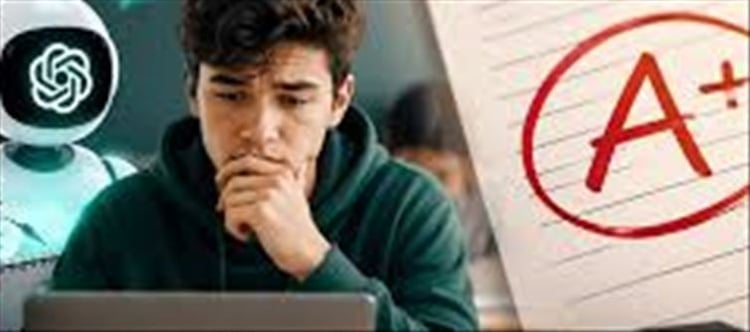

Artificial Intelligence is rapidly transforming education. From solving complex equations to generating essays in seconds, AI tools are helping students score better marks than ever before. Across schools, colleges, and competitive exam coaching centers, students are increasingly relying on AI-powered platforms to improve productivity, prepare assignments, and clear doubts instantly.
But while AI may help create academic toppers, experts warn that it does not automatically guarantee employability. Companies today are looking beyond marksheets and focusing more on practical skills, creativity, communication, and problem-solving abilities — areas where overdependence on AI can sometimes become a weakness.
The Rise of AI in Education
AI-powered tools such as ChatGPT, coding assistants, automated learning apps, and adaptive test-preparation platforms have become common among students.
These tools can:
Generate notes instantly
Solve mathematical problems
Explain difficult concepts
Write assignments and essays
Create presentations
Help with coding projects
Translate and summarize information
As a result, students are able to complete academic tasks faster and often score better in examinations.
Many educational institutions are also integrating AI into classrooms to personalize learning experiences and improve efficiency.
Why students Are Becoming “AI Toppers”
The modern education system often rewards:
Faster completion of tasks
Accurate theoretical answers
High exam scores
Efficient memorization
AI excels in all these areas.
Students using AI can:
Access instant explanations
Practice unlimited mock questions
Generate structured answers quickly
Improve grammar and presentation quality
This creates a competitive advantage in traditional academic systems.
In some cases, students who understand how to use AI effectively outperform peers who rely only on conventional studying methods.
The Employability Problem
Despite academic success, recruiters increasingly report that many graduates lack real-world skills required in workplaces.
Several companies say candidates struggle with:
Independent thinking
Communication skills
Team collaboration
Creativity
Practical problem-solving
Decision-making under pressure
AI can provide answers, but employers want individuals who can:
Analyze situations
Handle ambiguity
Build original ideas
Communicate effectively with teams and clients
A student who depends entirely on AI-generated solutions may find it difficult to perform when real-world situations demand human judgment.
Marks vs Skills: The Growing Gap
The traditional education model often measures performance through marks and grades. However, the job market values outcomes differently.
Today’s employers prioritize:
Hands-on experience
Internships
Project portfolios
Critical thinking
Adaptability
Emotional intelligence
Industry-specific expertise
A candidate with average grades but strong practical abilities may sometimes outperform a high-scoring student during interviews and workplace evaluations.
This growing disconnect between academic achievement and employability is becoming a major concern globally.
AI Dependency Can Reduce Deep Learning
One major concern among educators is that excessive AI usage may reduce genuine learning.
For example:
Students may copy AI-generated assignments without understanding concepts
Coding learners may rely on AI without practicing logic building
Essay writers may stop developing original writing skills
Over time, this can weaken:
Memory retention
Analytical thinking
Creativity
Research ability
Experts believe AI should support learning — not replace it.
Companies Are Changing Hiring Methods
As AI-generated resumes, assignments, and coding solutions become common, companies are redesigning recruitment processes.
Many employers now focus more on:
Live problem-solving rounds
Practical tasks
Group discussions
Behavioral interviews
Real-time coding tests
Portfolio evaluations
Recruiters want to understand how candidates think, not just what they can generate using AI tools.
Some firms are even testing “AI-assisted work ability” — evaluating whether candidates can use AI productively while still contributing human creativity and judgment.
The Future Workplace Will Require Human-AI Collaboration
AI is unlikely to replace all jobs completely. Instead, the future workplace will likely reward people who know how to work alongside AI effectively.
The most valuable professionals may be those who can:
Use AI for productivity
Verify AI-generated outputs
Think critically
Solve unique problems
Communicate ideas clearly
Lead teams and projects
In other words, AI literacy will become important, but human capabilities will remain essential.
Students Need a Balanced Approach
Experts recommend students use AI as:
A learning assistant
A productivity tool
A research companion
—but not as a complete replacement for effort and understanding.
Students should continue building:
Practical experience
Communication skills
Creativity
Technical depth
Real-world exposure
Combining human intelligence with AI tools can create stronger career opportunities than depending on automation alone.
Educational Institutions Face New Challenges
Schools and colleges are now under pressure to redesign teaching and evaluation systems.
Many educators believe future education should focus more on:
Skill-based learning
Practical applications
Collaborative projects
Innovation
Critical thinking
Ethical AI usage
Traditional memorization-based testing may become less relevant in an AI-driven world.
Final Thoughts
AI is undeniably helping students achieve better academic performance. It can save time, simplify learning, and improve productivity dramatically. However, marks alone are no longer enough in a rapidly evolving job market.
The future belongs not to those who merely use AI for shortcuts, but to those who combine AI efficiency with human creativity, adaptability, and real-world skills.
AI may help create toppers — but sustainable careers will still depend heavily on human capability.
Disclaimer:
The views and opinions expressed in this article are those of the author and do not necessarily reflect the official policy or position of any agency, organization, employer, or company. All information provided is for general informational purposes only. While every effort has been made to ensure accuracy, we make no representations or warranties of any kind, express or implied, about the completeness, reliability, or suitability of the information contained herein. Readers are advised to verify facts and seek professional advice where necessary. Any reliance placed on such information is strictly at the reader’s own risk.
 click and follow Indiaherald WhatsApp channel