


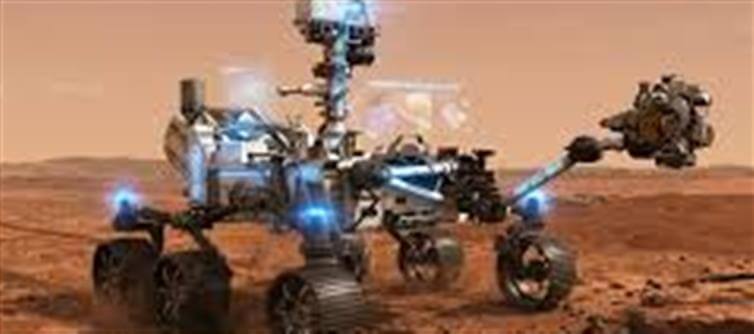

In a landmark breakthrough for space exploration, NASA’s Perseverance rover has made space history by driving across the Martian surface using artificial intelligence (AI) to plan its route — without human navigators on Earth having to plot every step.
This unprecedented achievement marks a major leap forward in how robotic explorers can operate independently on distant planets, paving the way for more efficient missions and deeper scientific discovery.
🧠 AI Takes the Driver’s Seat on Mars
Traditionally, NASA’s rover teams on Earth study images and terrain data from orbit and then carefully sketch out driving paths for Mars rovers several sols (Martian days) in advance. This process accounts for obstacles like rocks, deep sand, and steep slopes, and then sends instructions home via NASA’s Deep Space Network.
But during testing on Sol 1707 and Sol 1709 of the mission, engineers let a generative AI system take over the route‑planning task. Using high‑resolution imagery from the HiRISE camera on the Mars Reconnaissance Orbiter and detailed terrain data, the AI:
- Identified hazards such as boulders, sand ripples, and uneven ground.
- Generated a complete driving path with waypoints.
- Supplied instructions that Perseverance could execute autonomously.
Because of communication delay — up to ~20 minutes one way between Earth and Mars — real‑time remote control isn’t possible. AI planning removes that limitation and gives the rover smarter, faster decision‑making on the ground.
🚗 Historic Drives on the red Planet
On December 8 and december 10, 2025, Perseverance successfully followed AI‑generated navigation routes. The rover:
- Drove about 689 feet (210 meters) on the first AI‑planned route.
- Traveled about 807 feet (246 meters) on the second.
- Completed these autonomous runs safely across Martian terrain — a first for any robotic explorer.
NASA’s Jet Propulsion Laboratory (JPL) verified the AI’s plans by running them through a “digital twin” simulation — a virtual replica of the rover’s systems — before sending commands to Mars.
🔭 Why This Matters for Space Exploration
This achievement demonstrates that advanced AI can:
- Reduce the burden on Earth‑based planners, letting rovers cover more ground with less oversight.
- Increase science return by enabling longer and smarter autonomous navigation.
- Set the stage for future missions, including longer treks on Mars, lunar surface operations, and even exploration of distant icy moons or asteroids.
NASA officials say this capability could become part of routine rover operations, making robotic explorers even more independent.
🧪 An Intelligent Future on Mars
Perseverance’s historic AI‑planned drives signal the beginning of a new era in planetary robotics — one where smart machines help scientists make discoveries farther from Earth, faster, and with greater autonomy than ever before.
Whether it’s mapping ancient riverbeds, searching for signs of past life, or preparing for human explorers, AI‑assisted Mars rovers are rewriting what’s possible in space.
Disclaimer:
The views and opinions expressed in this article are those of the author and do not necessarily reflect the official policy or position of any agency, organization, employer, or company. All information provided is for general informational purposes only. While every effort has been made to ensure accuracy, we make no representations or warranties of any kind, express or implied, about the completeness, reliability, or suitability of the information contained herein. Readers are advised to verify facts and seek professional advice where necessary. Any reliance placed on such information is strictly at the reader’s own risk.
 click and follow Indiaherald WhatsApp channel