


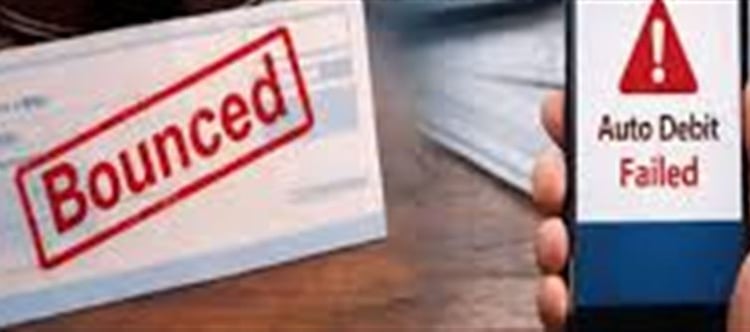

In India, the legal framework around payment failures makes an important distinction:
1. cheque Bounce Is a Legal Offence (Section 138, Negotiable Instruments Act)
- When you issue a cheque and it is presented to the bank, the bank may return it unpaid (i.e., bounce) for reasons like insufficient funds, signature mismatch, or invalid cheque details.
- If a cheque bounces due to insufficient funds, this can be treated as a criminal offence under Section 138 of the Negotiable Instruments Act, 1881.
- Once the payee sends a legal demand notice to the cheque issuer and the drawer doesn’t pay within the statutory period, the payee can file a criminal complaint in court.
Penalties for cheque bounce under Section 138 include:
✔ Fine (up to twice the cheque amount)
✔ Imprisonment (up to 2 years)
✔ Both fine and imprisonment possible on conviction
→ So, cheque bounce can lead to legal action, including court cases and criminal liability if conditions are met.
2. Auto‑Debit or Mandate Failures Are Not Automatically cheque Bounce Cases
Now, about auto‑debit failures (e.g., when an ECS/NACH auto‑debit for an EMI, bill, SIP or loan payment fails due to lack of funds):
- These failures are not the same as a bounced cheque under Section 138.
- A failed auto‑debit does not by itself trigger criminal prosecution under the Negotiable Instruments Act because the criminal law applies specifically to dishonour of cheques.
Instead, auto‑debit failures usually lead to:
✔ Bank or lender penalty/late fees (e.g., ₹250–₹750 per failed instance).
✔ Negative impact on credit score because repeated failures signal risk to lenders.
✔ Internal collection action by the creditor or bank (calls, notices, recovery steps).
So, you won’t automatically face a Section 138 legal case just because an auto‑debit didn’t go through — unless there was a cheque involved.
3. Real‑World Example: cheque vs Auto‑Debit
Suppose you set up an auto‑debit for your credit card or loan EMI but forget to maintain funds:
📌 Auto‑debit fails → lender may charge penalty, report to bureau, send recovery notices, but no automatic criminal case.
📌 Cheque you issued for the same payment bounces → payee can send a demand notice and potentially file a Section 138 cheque bounce case in court if you don’t pay within the legal notice period.
The legal implications are very different because cheque dishonour has a specific statutory offence tied to Section 138 of the Negotiable Instruments Act, whereas auto‑debit failures are primarily treated as contractual or financial defaults.
4. So Will Auto‑Debit Failures Cause Cheque‑Bounce Action?
No.
✨ A failed auto‑debit mandate alone does not result in “cheque‑bounce action.”
What could happen instead:
✔ Your lender may charge penalties and fees.
✔ They may report defaults to credit bureaus.
✔ Your account may go to internal collections or recovery teams.
But unless you actually issued a cheque that got dishonoured, you cannot be prosecuted under the Negotiable Instruments Act for cheque bounce purely because of an auto‑debit failure.
5. Best Practical Advice
To avoid problems when payments fail:
✅ Maintain sufficient funds in the account before the debit date.
✅ Communicate with the lender ahead of time if you know funds may be low — sometimes they can defer payments or restructure.
✅ For cheques, ensure all details are correct and that funds will be available on deposit.
✅ If your auto‑debit or cheque fails, act quickly to make the payment manually and notify the other party.
Bottom Line
➡️ Auto‑debit failures ≠ automatic cheque bounce action.
➡️ Only a bounced cheque — as formalised under Section 138 of the Negotiable Instruments Act — can trigger legal action, fines, or imprisonment.
Disclaimer:
The views and opinions expressed in this article are those of the author and do not necessarily reflect the official policy or position of any agency, organization, employer, or company. All information provided is for general informational purposes only. While every effort has been made to ensure accuracy, we make no representations or warranties of any kind, express or implied, about the completeness, reliability, or suitability of the information contained herein. Readers are advised to verify facts and seek professional advice where necessary. Any reliance placed on such information is strictly at the reader’s own risk.
 click and follow Indiaherald WhatsApp channel