


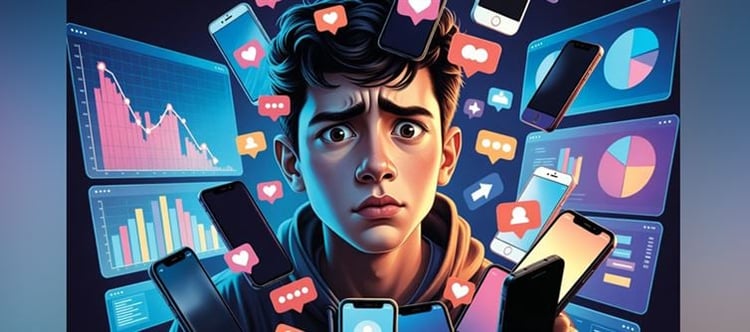

The “Gen Z Has the Lowest IQ” Claim — Let’s Slow Down
A viral claim is making the rounds: Gen Z has the lowest average IQ of any modern generation. Some reports point to declining standardized test scores and suggest that today’s young people are underperforming in areas like attention, memory, literacy, numeracy, executive function, and overall cognitive ability.
It sounds alarming. Almost apocalyptic.
But before we declare intellectual collapse, we need context.
Yes, several large-scale assessments in Western countries have shown dips in standardized academic performance in recent years. Some researchers have described this as a reversal of the long-observed “Flynn effect,” where IQ scores rose steadily across generations throughout the 20th century.
However, that doesn’t automatically mean Gen Z is “less intelligent.” It means something is shifting.
1️⃣ Test Scores Are Falling in Some Regions — But Why?
Data from certain Western nations shows stagnation or decline in academic benchmarks. Researchers have floated multiple explanations:
Increased screen time and wallet PLATFORM' target='_blank' title='digital-Latest Updates, Photos, Videos are a click away, CLICK NOW'>digital multitasking
Reduced deep reading habits
Pandemic-related educational disruption
Changes in testing formats
Environmental and socioeconomic stressors
IQ and standardized tests measure specific cognitive skills under controlled conditions. They don’t capture creativity, adaptability, wallet PLATFORM' target='_blank' title='digital-Latest Updates, Photos, Videos are a click away, CLICK NOW'>digital fluency, or emotional intelligence — areas where Gen Z arguably thrives.
Declining test performance does not equal genetic regression.
2️⃣ The Overconfidence Argument
Some commentators argue that young people today overestimate their abilities — citing studies on self-assessment biases.
But overconfidence isn’t new. Every generation has been accused of it.
Confidence gaps often reflect cultural shifts: social media visibility, constant comparison, and performative achievement can distort self-perception. That’s a social phenomenon, not proof of widespread cognitive decline.
3️⃣ Is This “Intentional”?
The idea that cognitive decline is a deliberate outcome engineered “by those in power” is a serious claim — and one that requires evidence.
Large-scale shifts in educational outcomes are typically tied to structural factors: school funding, curriculum changes, family income disparities, mental health trends, nutrition, and technology habits.
Complex societal changes rarely boil down to a single mastermind theory.
4️⃣ What About china and Japan?
Comparisons between countries can be tricky. Different nations use different testing systems, educational structures, and sampling methods.
Some east Asian countries consistently perform highly on international academic assessments, often attributed to rigorous educational cultures, strong math foundations, and standardized national curricula.
But that doesn’t mean IQ is universally rising there or universally falling elsewhere. Cross-national comparisons require nuance, not headlines.
5️⃣ The Immigration Narrative
Blaming cognitive trends on immigration from “low-IQ countries” is both oversimplified and scientifically flawed.
IQ is influenced by environment, education access, nutrition, socioeconomic conditions, language exposure, and test familiarity. Research consistently shows that when individuals from disadvantaged backgrounds gain access to improved educational and environmental conditions, cognitive test scores often rise.
Population-level shifts can’t be reduced to one demographic factor without ignoring a vast body of research on developmental psychology and public health.
6️⃣ The Bigger Question: Are We Measuring the Right Things?
If Gen Z struggles with sustained attention but excels at rapid information processing, is that decline — or adaptation?
If they read fewer books but navigate complex wallet PLATFORM' target='_blank' title='digital-Latest Updates, Photos, Videos are a click away, CLICK NOW'>digital ecosystems instinctively, is that cognitive weakness — or a different skill set?
Standardized metrics were built for a different era.
The world changed. The tools didn’t.
The Real Conversation We Should Be Having
Instead of declaring intellectual doom, maybe we should ask better questions:
How is technology reshaping cognition?
Are schools adapting fast enough?
What did pandemic disruption do to learning trajectories?
How do stress and mental health impact academic performance?
It’s easy to frame generational change as decay. history shows every generation has faced that accusation.
The challenge isn’t to panic.
It’s to understand what’s changing — and respond thoughtfully.
Because if there’s one thing humanity has consistently proven, it’s this: we adapt.
The story isn’t over.
 click and follow Indiaherald WhatsApp channel