


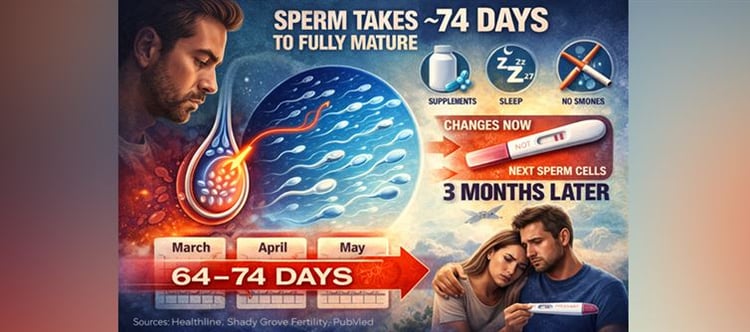

The 3-Month Reality Check No One Mentions
When couples start trying to conceive, the spotlight almost always lands on the woman. Her cycle. Her hormones. Her timing.
But here’s the biological truth most people overlook: sperm doesn’t work on a weekly timeline. It works every quarter.
On average, sperm takes about 64 to 74 days to fully develop — and that doesn’t even include the additional time it spends maturing and traveling through the reproductive tract. From start to finish, you’re looking at roughly two to three months before a sperm cell is ready for action.
Which means the sperm your partner produces today actually began forming months ago.
Let that sink in.
1️⃣ Fertility Is Not an Overnight Fix
This is where many couples get frustrated.
He starts supplements.
He cuts back on alcohol.
He improves sleep.
A week later? Nothing has changed.
Of course it hasn’t.
The sperm being produced right now were already in development long before those changes began. Biology doesn’t hit refresh because you bought a new vitamin bottle.
Consistency over three months — that’s what moves the needle.
2️⃣ Science Backs the Timeline
Medical research consistently estimates spermatogenesis — the process of sperm production — at around 64–74 days. Some sources cite a broader range, roughly 42–76 days, depending on individual variation.
But here’s the key: lifestyle shifts affect the next generation of sperm, not the current one.
Better nutrition, reduced stress, improved sleep, quitting smoking — these changes matter. They just need time to show up in measurable sperm quality: count, motility, morphology, and dna integrity.
It’s a delayed reward system.
3️⃣ The “We’ll Fix It After a Negative Test” Trap
This is one of the biggest mistakes couples make.
They wait for a negative pregnancy test.
Then they scramble.
But by that point, the sperm involved in that cycle were set in motion months earlier.
If you’re trying to conceive, he shouldn’t start optimizing after disappointment. He should start before you even begin.
Because the clock is already ticking — just not in the way most people think.
4️⃣ What Actually Makes a Difference
Over a sustained 2–3 month period, research suggests improvements may come from:
Consistent antioxidant support (like zinc, CoQ10, vitamin c & E)
Maintaining a healthy weight
Limiting alcohol
Avoiding smoking and recreational drugs
Reducing excessive heat exposure (yes, that matters)
Managing stress
Getting quality sleep
Notice the pattern? None of this works as a quick fix. It’s a lifestyle shift, not a seven-day reset.
5️⃣ Fertility Is a Two-Person Equation
There’s a cultural tendency to treat conception as primarily a woman’s responsibility. Track the cycle. Take the supplements. Schedule the appointments.
But male fertility plays an equal role — and operates on its own biological timeline.
If pregnancy is the goal, preparation has to be shared.
The Bottom Line
Sperm takes roughly three months to fully develop. That’s not a theory. It’s biology.
So if you’re trying to conceive, think long-term.
Think consistency.
Think 90-day strategy — not weekend solutions.
Because when it comes to male fertility, today’s choices show up in three months.
And by then, you’ll either be glad you started early — or wishing you had.
 click and follow Indiaherald WhatsApp channel