


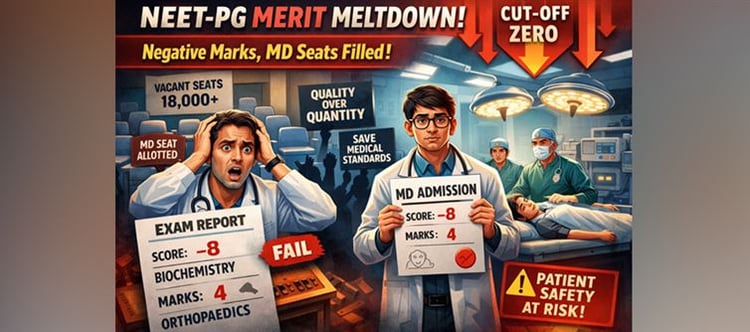

🚨 NEET-PG 2026: When Cutoffs Hit Rock Bottom
India’s postgraduate medical admissions are facing one of their most explosive moments yet. During NEET-PG 2026 counselling, qualifying percentiles were reportedly lowered to zero — and in some categories effectively below traditional thresholds — to fill more than 18,000 vacant seats across specialties.
The result?
Admissions in branches like Biochemistry and MS Orthopaedics are reportedly going to candidates with extremely low raw scores, including negative marks in certain cases.
What was intended as a vacancy-filling mechanism has now triggered a full-scale debate over merit, standards, and the future of medical training in India.
⚖️ 1. The Decision: Why Were Percentiles Lowered?
The NEET-PG exam is conducted by the National Board of Examinations in Medical Sciences (NBEMS), and percentile cutoffs determine eligibility for counselling.
This year, with thousands of seats remaining vacant after earlier rounds, authorities lowered qualifying percentiles to zero to ensure seats did not go unfilled.
The rationale:
Prevent infrastructure waste
Address specialist shortages
Avoid financial strain on institutions
On paper, it’s a logistical solution.
In practice, it has become a reputational crisis.
🧮 2. Negative Marks, Real Seats
Reports indicate that in certain non-clinical and clinical specialties:
Candidates with single-digit scores secured seats
Some negative raw scores cleared counselling thresholds
While percentile is a relative ranking (not absolute marks), the optics are explosive.
Doctors across platforms began asking:
If entrance standards collapse, what happens to exit competence?
🏥 3. The Patient Safety Question
Critics argue that postgraduate training shapes the next generation of specialists.
If entry filters weaken significantly, concerns emerge around:
Academic rigour
Clinical decision-making
Long-term quality of care
Public trust in doctors rests on the assumption that training is competitive and rigorous.
When headlines highlight “minus scores securing MD seats,” that trust feels tested — even if training itself remains stringent.
🧠 4. Is This About Merit — Or a Systemic Mismatch?
Supporters of the move argue the real issue lies elsewhere:
Rapid expansion of PG seats without proportional applicant readiness
Uneven distribution of specialties
Candidates avoiding certain branches
Rural and non-clinical seats are remaining unattractive
In other words, the system may be producing more seats than demand in specific streams.
Lowering percentiles becomes a corrective lever — not a philosophical shift.
🔥 5. The Merit vs Access Debate Rekindled
The controversy has revived a long-running argument in indian education:
Should standards be relaxed to maximize seat utilization?
Or should vacant seats remain vacant to preserve competitiveness?
Some voices, including commentators like Dr. anand Ranganathan, have warned that drastic percentile reductions dilute merit and send the wrong signal about India’s medical standards.
Others counter that NEET-PG ranking does not fully determine clinical capability — and training years still matter.
The divide is sharp.
📉 6. What 18,000 Vacancies Really Mean
The number itself is telling.
If tens of thousands of postgraduate seats remain vacant until cutoffs are slashed, it suggests:
Structural imbalance in specialty preference
Migration of top candidates abroad
Perceived return-on-investment disparities
Merit debate aside, the vacancy crisis signals a deeper planning mismatch in medical education expansion.
🌍 7. Global Comparisons: Would This Fly Elsewhere?
In most countries, medical specialization programs remain fiercely competitive with strict entry benchmarks.
If india is seen internationally as lowering thresholds dramatically, it may affect:
Perception of medical education quality
Academic exchange credibility
Future global recognition debates
Reputation in medicine travels far beyond borders.
⚠️ 8. The Long-Term Question
Lowering percentiles fills seats immediately.
But long term?
Will academic performance in residency reflect initial low scores?
Will dropout rates change?
Will competency exams tighten?
The real test of this policy won’t be counselling data.
It will be clinical outcomes years from now.
🔍 Final Word
The NEET-PG 2026 counselling decision was meant to solve a numbers problem.
Instead, it has created a confidence problem.
Medicine thrives on excellence, discipline, and trust.
If reforms are needed to balance workforce shortages with standards, they must be transparent, data-driven, and defensible.
Because in healthcare, the margin for error is never theoretical.
It is human.
 click and follow Indiaherald WhatsApp channel