
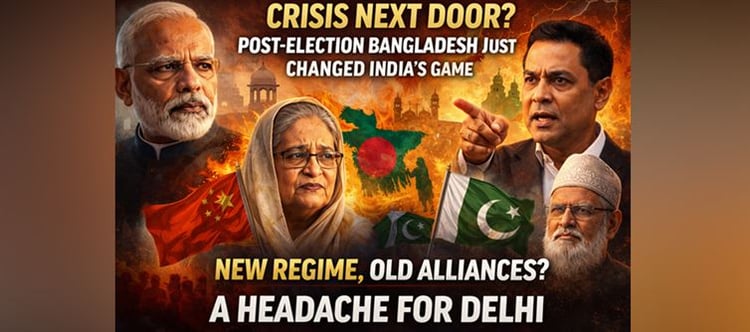


🚨 india Has a New Problem — And It’s Not Fading Anytime Soon
The 2024 regime change in bangladesh has redrawn South Asia’s political chessboard — and New delhi is staring at a far more complicated eastern frontier.
With the Bangladesh Nationalist Party (BNP) returning to power and the Jamaat-e-Islami Bangladesh emerging as the principal opposition, India’s carefully cultivated ties with Dhaka are entering turbulent waters.
This isn’t routine political turnover. This is a recalibration of ideology, alliances, and regional leverage.
Here’s why Delhi’s strategic comfort zone just shrank.
⚔️ 1. The Hasina Factor — Refuge, Extradition, and Pressure Politics
Former prime minister Sheikh Hasina, long seen as India’s most dependable partner in Dhaka, now represents a diplomatic flashpoint.
The BNP, led by Tarique Rahman, has historically positioned itself as her fiercest rival. If india continues to provide refuge or political cover, Dhaka could link bilateral cooperation — trade, transit, security — to extradition demands.
This transforms a humanitarian or legal issue into a geopolitical bargaining chip.
delhi must now weigh legal principles against regional strategy.
🌏 2. Rewriting 1971 — A Narrative Shift with Strategic Consequences
The BNP has distanced itself from the legacy of Sheikh Mujibur Rahman, the architect of Bangladesh’s liberation in 1971 — a moment deeply intertwined with India’s military and diplomatic support.
That symbolic recalibration matters.
If Dhaka softens its ideological alignment with India’s historic role and opens doors to warmer ties with Pakistan, the strategic equilibrium shifts.
Add to that China’s entrenched infrastructure and economic footprint in bangladesh, and the potential for a Beijing-Islamabad-Dhaka alignment becomes more than theoretical.
🔫 3. The Security shadow — ULFA, Assam, and Cross-Border Risks
Tarique rahman has previously faced allegations linked to weapons smuggling networks connected to the United Liberation Front of Asom (ULFA), a separatist group operating in India’s northeast.
While past accusations do not automatically define future policy, they shape perception — especially in security circles.
India’s northeast has stabilized significantly in recent years. Any ambiguity in Dhaka’s counter-insurgency cooperation could reopen old vulnerabilities.
Security collaboration, once a strength of Indo-Bangladesh ties, may now require delicate renegotiation.
🕌 4. Jamaat’s Rise — Political islam Back in the Frame?
The emergence of Jamaat-e-Islami as the principal opposition signals shifting ideological currents within Bangladesh.
Once politically marginalized, the party’s strengthened position suggests growing religious polarization.
For india, the concern isn’t simply domestic politics in Dhaka — it’s whether bangladesh could become fertile ground for radical networks, potentially influenced by elements within Pakistan’s intelligence ecosystem.
The risk may not be immediate — but the possibility demands vigilance.
🧭 5. Delhi’s Balancing Act
india cannot afford instability along its 4,000-kilometre eastern border.
bangladesh is a critical partner in trade corridors, energy connectivity, river water agreements, and counter-terrorism coordination.
The challenge for New delhi is to avoid reactive posturing while safeguarding strategic interests. Engagement must remain pragmatic, not emotional — even if rhetoric from Dhaka sharpens.
⚡ 6. The china Variable — The Silent Power Player
China’s infrastructure investments — ports, bridges, power plants — have already woven beijing into Bangladesh’s economic architecture.
A BNP-led government more open to recalibrating alliances could accelerate this influence.
For india, which views the Bay of bengal as central to its maritime and strategic doctrine, this is not a distant concern. It’s immediate.
🔥 The Bottom Line
Bangladesh’s political reset has introduced uncertainty into one of India’s most stable neighbourhood relationships.
Whether this evolves into confrontation, cautious coexistence, or renewed partnership depends on choices made in both capitals.
What is clear is this:
India’s eastern policy just got more complicated.
And in South Asia, complexity rarely fades quietly.
 click and follow Indiaherald WhatsApp channel