


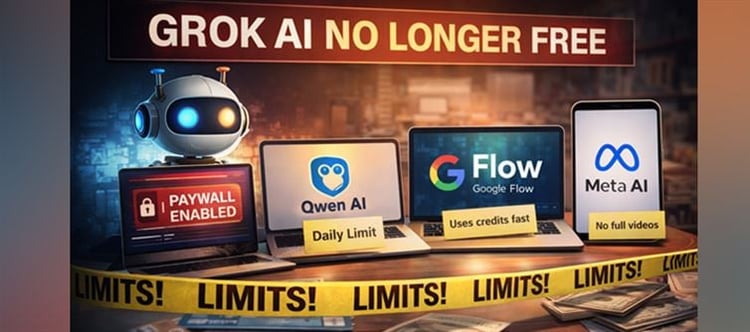

For a lot of creators, the appeal of tools like Grok wasn’t just what they could do—it was that they could do it for free. That’s over now. And with that shift, the entire “free AI content” illusion is starting to crack.
Because here’s the reality: powerful AI video generation isn’t cheap—and it never really was.
Now that Grok has moved behind a paywall, creators are being forced to adapt. Not by finding one perfect replacement—but by stitching together multiple tools that each solve part of the puzzle.
Let’s break down what that looks like.
First up, Alibaba’s Qwen AI. It’s solid for short-form AI videos and creative experiments. The catch? Daily limits. You can’t just keep generating endlessly—you hit a wall fast.
Then there’s Google’s Flow, part of its Veo and gemini ecosystem. This is where things get serious in terms of quality. But it runs on credits—and those credits disappear quickly. One or two projects in, and you’re already thinking about the next recharge.
And finally, Meta AI. Great for ideas, scripts, visuals—basically everything around the video. But not the video itself. No full production, no lip-sync, no final output.
Which leads to the uncomfortable truth.
There is no fully free, all-in-one solution anymore.
The new strategy isn’t convenient—it’s a combination. One tool for ideation. Another for visuals. A third for execution. It’s more effort, more planning, and sometimes more cost.
But that’s where the space is heading.
Because as AI gets better, it also gets monetized.
And creators who adapt early—who learn how to mix tools instead of relying on one—won’t just survive this shift.
They’ll dominate it.
 click and follow Indiaherald WhatsApp channel