
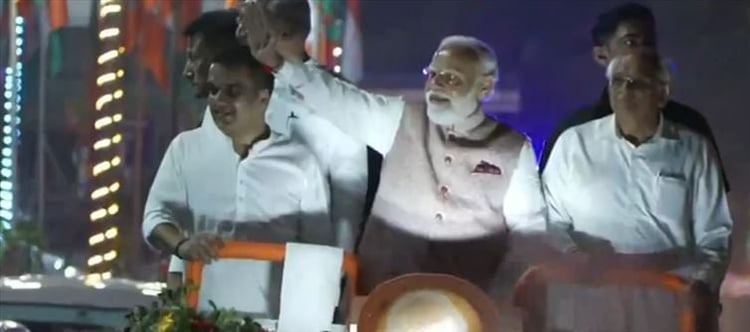


Whenever governments ask citizens to “sacrifice for the nation,” people usually expect one thing in return: leaders setting the example themselves. That’s why criticism is growing online after prime minister Narendra Modi urged people to save petrol and diesel amid global uncertainty — while simultaneously continuing multiple large-scale political roadshows.
According to critics, the contradiction is difficult to ignore.
In just two days, Modi reportedly held roadshows in Jamnagar, Gir Somnath, and Vadodara. Massive public events, extensive security arrangements, long vehicle convoys, heavy logistics, and large-scale political mobilization — all while ordinary citizens are being encouraged to reduce fuel consumption “for the nation.”
And that is exactly what has triggered frustration online.
Because people are no longer reacting only to policies. They are reacting to optics. To symbolism. To the growing perception that austerity is often expected only from the public, never from those in power. Middle-class families are already dealing with rising fuel prices, inflation, shrinking savings, and increasing economic anxiety. So when citizens hear messages about conserving fuel while watching high-energy political spectacles continue uninterrupted, the messaging starts feeling inconsistent.
Critics argue that if the global crisis is genuinely serious enough to demand public sacrifice, then leadership should visibly reflect the same urgency. Fewer large-scale events. Reduced convoy culture. More restrained political campaigning. Symbolic gestures matter during difficult times because they signal shared responsibility.
Of course, supporters may argue that political outreach and governance cannot stop entirely during economic challenges. But in politics, perception often becomes reality.
And right now, the perception spreading across social media is brutally simple: ordinary citizens are being asked to tighten their belts while politics continues at full speed.
 click and follow Indiaherald WhatsApp channel