


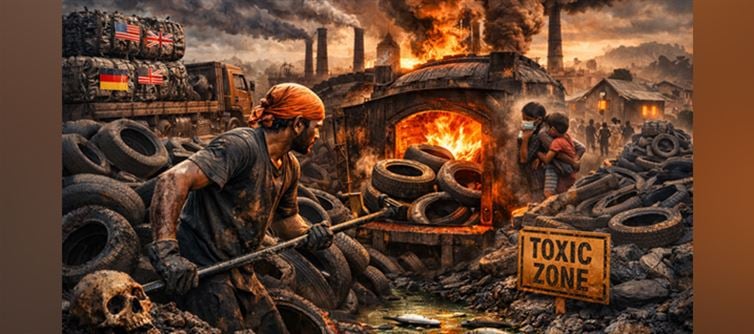

Every night, when the wind shifts westward, villages around Morena in madhya pradesh stop breathing easy.
Black soot settles on rooftops. Toxic smoke creeps into lungs. Water turns oily. Crops darken. Sleep vanishes. cancer moves in silently.
Nine kilometres away, inside the Jaderua Industrial Area, tyres from across the world are being cooked alive. Branded as “recycling,” the process is nothing more than mass incineration—unchecked, under-regulated, and lethal. Imported waste rubber from rich nations is burned in India’s poorest regions, while paperwork pretends everything is legal.
This is not an accident.
This is policy failure, regulatory blindness, and profit-driven pollution—working exactly as designed.
india didn’t just inherit the world’s waste tyre problem.
It invited it in, lit the furnace, and looked away.
🧨 HOW india BECAME THE WORLD’S WASTE TYRE FURNACE
1️⃣ Villages That Breathe Poison After Sunset
In Lohgarh and 13 surrounding villages, nights are unlivable. As furnaces ignite, carcinogenic gases—PAHs, dioxins, furans, nitrogen oxides—ride the wind straight into homes. Roofs, crops, livestock, and lungs are coated in carbon black. This is not “environmental impact.” This is slow, systematic poisoning.
2️⃣ Pyrolysis Plants That Ignore Borders—and Human Lives
Thirteen tyre pyrolysis oil (TPO) plants operate in Lohgarh alone, converting tyres into oil, steel, and soot. Their emissions don’t stop at factory walls. They spill into villages, fields, ponds, and rivers—turning entire ecosystems into dumping grounds for toxic residue.
3️⃣ A Ban That Exists Only on Paper
india banned the import of waste tyres for pyrolysis in 2022. Enforcement? Non-existent. There’s no tracking system, no end-use verification, no accountability. Imports didn’t fall. They exploded—rising fivefold in four years.
4️⃣ The HS Code Loophole That Lets cancer Walk In
Scrap tyres don’t have a specific HS Code. They’re lumped under “rubber scrap.” Customs officers have to physically inspect shipments to stop illegal imports—if they want to. Most don’t. Paperwork glides through. pollution follows.
5️⃣ Rich Countries Export Trash. india Pays for It.
The UK, USA, Australia, Germany, gulf nations—countries that can’t manage their own tyre waste—ship it to India. Not for clean recycling, but for cheap burning. india doesn’t just accept this waste. It pays to import pollution.
6️⃣ From Port to Pyre: The Hidden Supply Chain
At ports, tyres are sorted.
• 30% are resold as second-hand tyres—back onto indian roads.
• The rest are routed via warehouses, whatsapp groups, cash deals, and night-time trucking—straight to illegal pyrolysis plants.
Official records say “certified recycling.” Reality says furnaces.
7️⃣ EPR: The Policy That Supercharged the Scam
Extended producer Responsibility (EPR) was meant to clean up tyre waste. Instead, it created a gold rush. Recyclers earn credits based on volume, not environmental safety. Burn more tyres—earn more money. Imported tyres are cheaper, dirtier, and more profitable. The result? A fivefold surge in imports.
8️⃣ workers Treated as Disposable Fuel
Inside the plants, labourers earn ₹500–800 a day to feed tyres into blazing furnaces—without masks, gloves, or helmets. They vomit, suffocate, and cough up soot. Their “safety gear” is jaggery, handed out to swallow carbon dust. workers rotate every 30 days because bodies can’t last longer.
9️⃣ cancer Clusters, Dead Rivers, Black Groundwater
Doctors, researchers, and locals report rising cancers, chronic respiratory disease, skin disorders, and neurological damage. Water contamination runs hundreds of feet underground. Ponds shine with oil slicks under moonlight. This is environmental collapse in slow motion.
🔟 The Illusion of Regulation
Inspection teams arrive only after factories are tipped off. Operations pause. Records are cleaned. Plants reopen within days. Despite court orders, SOPs, and laws, hundreds of unauthorized units continue operating—protected by money, politics, and silence.
1️⃣1️⃣ A Country Drowning in Its Own Waste—Yet Importing More
india generates 25 lakh metric tonnes of waste tyres annually. Its recycling capacity is already overstretched. Still, 18 lakh metric tonnes are imported every year. The math doesn’t add up—unless pollution is the product.
1️⃣2️⃣ Livelihood vs Life: The Cruel Trade-Off
For many villagers, these factories are the only source of income. ₹15,000 a month feeds families—but poisons their future. It’s not consent. It’s desperation. And the system exploits it mercilessly.
💣 CLOSING PUNCH
This is not recycling.
This is not development.
This is environmental outsourcing—where rich nations export their waste, corporations export accountability, and the poor inhale the consequences.
india didn’t just become the world’s waste tyre furnace.
It became the place where global pollution goes to disappear—along with human lives.
 click and follow Indiaherald WhatsApp channel