


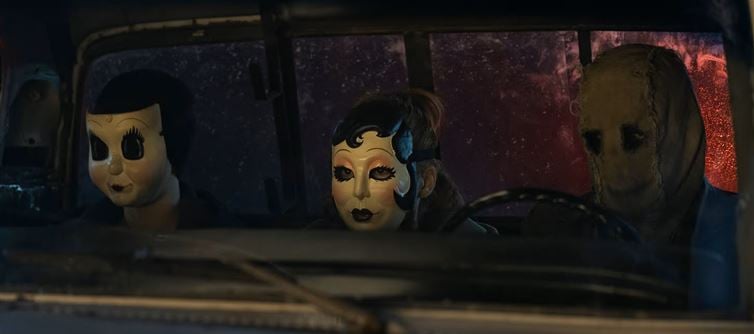

Some horror icons are terrifying precisely because we don’t understand them. The Strangers were never meant to be decoded, psychoanalysed, or handed a tragic childhood scrapbook. They were terrifying because they were unknowable. With Chapter 3, director Renny Harlin completes a trilogy that fundamentally misunderstands that truth — and in doing so, drains the franchise of every last drop of menace.
This final chapter doesn’t just end with a whimper; it arrives already exhausted, padded with flashbacks, limp mythology, and explanations nobody asked for.
Story & Structure: When Mystery Becomes Mundane
Picking up seconds after Chapter 2, the film opens with yet another obligatory flashback kill before plunging into narrative redundancy. The screenplay by Alan Freedland and Alan R. Cohen even pauses to define “serial killer” via an on-screen dictionary entry — an unintentionally hilarious admission of how little confidence the film has in its audience.
Maya, played by Madelaine Petsch, survives long enough to wander through forests, churches, and abandoned mills that feel less like locations and more like placeholders. The plot drags her through a stalk-and-slash routine so familiar it feels algorithmically generated, culminating in an underdeveloped attempt to turn her into the “next Stranger.” It’s an idea with potential — but one the film abandons almost immediately, as if startled by its own ambition.
Performances: Sleepwalking Through Terror
Madelaine Petsch does what she can, but the material gives her no room to evolve beyond “traumatised final girl on autopilot.” Richard Brake’s Sheriff Rotter hints at menace but is undermined by indecisive writing, while Gabriel Basso appears briefly, delivers exposition, and disappears — a human speed bump rather than a character.
The Strangers themselves? Reduced to the lore delivery systems. Once you start explaining Scarecrow’s past, the mask may as well come off — and with it, the fear.
Direction & Technicalities: Competent but Completely Lifeless
Harlin, once a reliable craftsman of pulpy tension (Die Hard 2, Cliffhanger), appears strangely disengaged. The camera moves, the scenes cut, the score hums — and yet nothing generates suspense. Even the violence lands with a dull thud, staged competently but without rhythm, escalation, or dread.
Cinematography and production design do their jobs, but never elevate the material. The film looks like a horror movie; it just doesn’t feel like one.
Themes & Analysis: Over-Explanation as Franchise Poison
The original The Strangers thrived on a simple, terrifying premise: because you were home. That randomness was the horror. Chapter 3 replaces that existential fear with backstory, motivation, and symbolism — the holy trinity of franchise self-sabotage.
In an era obsessed with cinematic universes and lore bibles, this trilogy commits the ultimate horror sin: it explains the monster. Once surprise is gone, there is nothing left to fear.
What Works
• A few technically competent chase sequences
• A fleetingly intriguing idea about replacing a Stranger
• One genuinely bizarre final moment that almost wakes the film up
What Doesn’t
• Over-explained mythology that kills tension
• Endless, pointless flashbacks
• Flat performances shackled by lifeless writing
• A tone so sedated it feels medicated
Final Verdict
The Strangers – Chapter 3 doesn’t just close the book on a trilogy — it underlines why some stories should never have been expanded in the first place. By stripping away mystery in favour of hollow explanation, Harlin delivers a finale that is dull, inert, and completely devoid of terror.
The Strangers were never meant to be understood.
Once they were, they became nothing at all.
 click and follow Indiaherald WhatsApp channel