


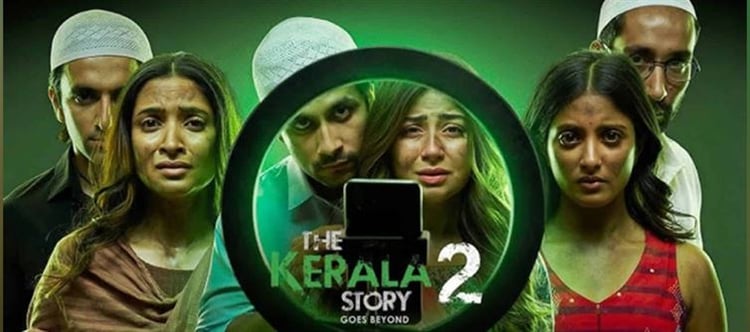

The Film That Did the Impossible — It United Kerala
In a state where political disagreements are practically a cultural sport, Kerala Story 2 has achieved something astonishing. It has brought rivals to the same side.
Across party lines — Left, Congress, even many who lean right — Malayalees have largely reacted with discomfort, anger, or outright rejection. people who would normally argue endlessly over ideology are, this time, nodding in agreement. And that alone tells you this isn’t just about a movie. It’s about what the movie claims.
Because this isn’t a minor controversy. It’s a narrative war.
1️⃣ The Claim That Lit the Fuse
A report by The Economic Times highlighted something explosive in the film’s now-withdrawn trailer: a suggestion that in 25 years, india could become an Islamic nation.
Pause for a moment.
india did not become an Islamic state during nearly six decades of Congress-led governance. But now, after eleven years under prime minister Narendra Modi — a government that positions itself as ideologically opposed to such an outcome — a film implies the country is on the brink of religious transformation.
That’s not just provocative storytelling. That’s a political statement.
And it raises a sharp, uncomfortable question:
If such a transformation is supposedly imminent, what does that imply about the present government’s control, strength, or narrative?
Shouldn’t those in power be the first to challenge such a suggestion?
Instead, silence.
2️⃣ The Backlash Wasn’t Partisan — It Was Personal
kerala has strong political identities. But this reaction wasn’t about party flags. It was about identity and representation.
Many Malayalees felt the title itself — Kerala Story 2 — framed the entire state within a controversial narrative, even though references reportedly extend beyond Kerala. Critics argued that attaching the state’s name to a sweeping communal claim risks painting millions with one brush.
In a region that prides itself on literacy, political awareness, and social coexistence, that struck a nerve.
This wasn’t just criticism. It was collective discomfort.
3️⃣ The kerala High court Steps In
On february 26, 2026 — just a day before release — the kerala High court pressed pause.
The court issued an interim stay for at least fifteen days, asking the Central Board of Film Certification (CBFC) to revisit its clearance. That’s not routine. That’s serious.
The court observed that the trailer and teaser had prima facie potential to disturb communal harmony. It questioned whether the Censor Board had fully weighed the film’s possible social impact before granting certification.
Even more telling: the court flagged the use of “Kerala” in the title as potentially misleading, given that the narrative reportedly touches on events beyond the state.
The judges sought a private screening. When that didn’t materialize, they relied on transcripts of promotional content to pass the interim order.
This wasn’t a casual delay. It was a legal red flag.
4️⃣ The Censor Board Under Scrutiny
The stay effectively puts the spotlight back on the CBFC.
The court has made it clear: a fresh, reasoned decision is required. Not a rubber stamp. Not a vague clearance. A considered evaluation of social consequences.
For a film dealing with religion, demographics, and national identity, the burden of responsibility is heavier. And now, that burden is squarely on the Board’s table.
5️⃣ The Road Ahead — supreme court Showdown?
Producer vipul Amrutlal Shah and his team may approach the supreme court to challenge the High Court’s interim order. That battle, if it happens, won’t just be about artistic freedom.
It will be about where storytelling ends, and provocation begins.
About whether cinema can speculate on national transformation without triggering social fracture.
About whether dramatic narrative can coexist with social responsibility.
The Bigger Picture
This episode isn’t merely about a stalled release. It’s about perception, politics, and power.
When a film suggests india could become an Islamic nation within decades, it does more than stir debate. It tests trust. It challenges governance narratives. It risks unsettling communal balance.
Kerala’s response wasn’t ideological theatre. It was a rare moment of consensus in a deeply divided political landscape.
And perhaps that’s the biggest twist of all.
Final Word
Kerala Story 2 set out to provoke conversation. It succeeded.
But in trying to ignite division, it appears to have united an entire state in skepticism.
Now the question shifts from the box office to the courtroom.
Because sometimes, the real drama doesn’t unfold on screen — it unfolds in the institutions that decide what makes it there.
 click and follow Indiaherald WhatsApp channel