



SEEN BUT NOT SAFE: HOW DRONES ARE EXPOSING THE WORLD’S MOST ISOLATED TRIBES
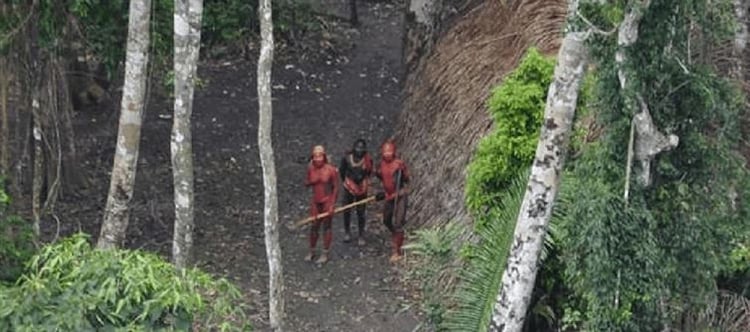
In an age where nothing escapes the lens, even those who have deliberately chosen not to be part of modern civilization are being pulled into its gaze. Recent drone footage from the amazon has ignited global shock—showing members of an uncontacted Indigenous community emerging near riverbanks, their bodies painted in striking red, staring back at machines they never consented to meet. This isn’t a sci-fi dystopia. This is happening now.
The images are believed to show the Mashco-Piro, one of the largest uncontacted Indigenous groups in the world, living deep within the Peruvian Amazon. And while the visuals are mesmerizing, the reality behind them is deeply unsettling.
1. THEY DID NOT SEEK US—WE FOUND THEM
The Mashco-Piro have avoided contact for generations, retreating deeper into the forest after violent encounters during the rubber boom and later incursions. Their isolation is not ignorance—it is a survival strategy. Drones hovering above their homes shatter that choice.
2. DRONES DON’T JUST RECORD—THEY INTRUDE
What looks like “documentation” to the outside world is an intrusion to an uncontacted tribe. The buzz of a drone can signal danger, provoke fear, or trigger defensive responses. For communities with no immunity to modern diseases, any contact—direct or indirect—can be fatal.
3. THE red BODY PAINT IS NOT ‘MODERN’—IT IS ANCIENT
social media speculation has wildly misread the visuals. The vivid red patterns are traditional body paint made from annatto seeds, used for generations by the Mashco-Piro. It protects against insects, sun exposure, and carries cultural meaning. It may look “aesthetic” or “futuristic” to outsiders—but it is authentic, functional, and sacred.
4. WHY THEY’RE NEAR RIVERS NOW
Recent footage (2024–2025) shows Mashco-Piro groups appearing more frequently near riverbanks. Experts believe this is due to:
Deforestation and logging pressure
Encroachment by outsiders
Shrinking hunting grounds
Ironically, they are becoming visible because their world is being destroyed.
5. UNCONTACTED DOES NOT MEAN UNPROTECTED
International law and Indigenous rights frameworks stress non-interference. Filming, sharing, and monetizing these images—especially without safeguards—risks turning protected humans into viral content.
6. THE DANGEROUS ROMANTICISM OF ‘FIRST CONTACT.’
History is brutally clear: first contact often brings disease, displacement, and death. Entire tribes have been wiped out not by violence, but by the common cold. Curiosity has consequences.
7. WHO GETS TO LOOK—AND WHO GETS TO DECIDE?
The hardest question is ethical, not technological:
Just because we can film them—should we?
The Mashco-Piro did not ask to be seen. Visibility, in their case, could be the first step toward erasure.
THE BIGGER TRUTH: technology HAS OUTRUN CONSENT
Drones, satellites, and social media have collapsed distance—but not responsibility. When the most isolated people on Earth are no longer safe from our curiosity, it’s time to ask whether progress has lost its moral brakes.
FINAL WORD: LET THEM REMAIN UNSEEN
The Mashco-Piro don’t need our attention.
They need space, protection, and silence.
Sometimes, the most humane act is not to document—but to look away.
 click and follow Indiaherald WhatsApp channel