


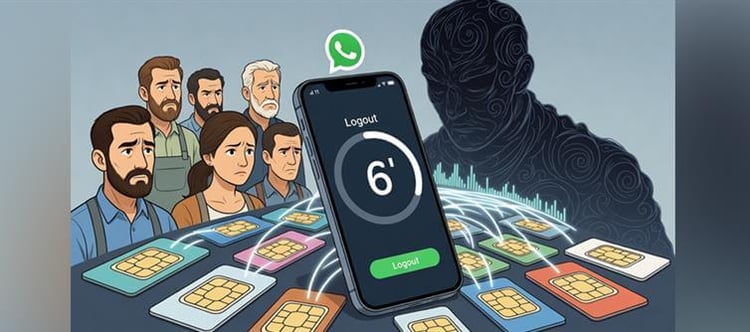

⚡A Simple Login Rule That Could Break Millions of Workflows
Imagine your business depends on your chat window staying open.
Customers ping. Orders come. Payments confirm.
Everything flows — until the clock hits six hours.
That’s the new reality for millions of indians from february 2026. Thanks to a fresh DoT mandate, whatsapp Web (and similar services) will now boot you out every six hours. No warning. No wriggle room.
What began as a move to fight fraud might end up suffocating side-hustles, small businesses, freelancers, and daily wage earners who live in chat windows.
Because in the name of security, your livelihood just got a reset button.
💥 WHAT CHANGED: THE NEW RULES AND WHY THEY MATTER
1️⃣ SIM Binding — Your Account, Your SIM, Always
Under the new directive, all apps that rely on mobile-number identification — whatsapp, Telegram, Signal, and others — must now implement continuous SIM binding. Meaning: your account will work only so long as the same SIM that registered it remains active and inserted.
Remove or swap the SIM, and the app stops working. Instantly. No grace period. No “use on Wi-Fi-only tablet” loophole anymore.
For many users — across freelance, small business, secondary-device users — that flexibility is gone.
2️⃣ whatsapp Web (and desktop clients) Get a 6-Hour Self-Destruct Timer
No more “set-and-forget.” Every web session must now auto-logout every six hours. After that, you must re-scan the QR code from your main phone (with the SIM inside) to continue.
If your SIM is switched off, lost, or out of coverage, you lose the web window instantly.
For people running micro-enterprises, support desks, delivery coordination, client chats, and customer service via whatsapp Web — this is not just an inconvenience. It’s a business disruption.
⚠️ WHY THIS LOOKS LIKE SECURITY — BUT HURTS ORDINARY USERS
3️⃣ The Official Pitch: Cyber Fraud, Spam & Traceability
The government claims the shift will close a major loophole: previously, apps verified the number once at install — after that, they kept working, even if the SIM was removed or moved abroad.
By enforcing SIM binding and periodic logout, DoT believes it will make it harder for fraudsters to misuse dormant numbers or hijacked accounts, increasing traceability and reducing scams.
In theory, totally understandable.
4️⃣ The Reality: Massive Inconvenience, business Risks & User Pain
But the side-effects are brutal:
• Small businesses using whatsapp Web for customer communication will face frequent interruptions — annoying clients, losing orders.
• Sellers managing multiple devices (phone + tablet + desktop) lose flexibility.
• people travelling, switching SIMs for coverage, or living in areas with unstable SIM networks lose access entirely.
• Freelancers, remote-support agents, and gig workers who rely on long chat sessions — their workflows get hit.
• Users on laptops or desktops without a permanently connected SIM card will find the service unusable after logging out.
For many, this isn’t a security update. It’s a productivity chokehold.
💡 THE BROADER IMPACT — BEYOND JUST LOGOUTS
5️⃣ A Blow to the wallet PLATFORM' target='_blank' title='digital-Latest Updates, Photos, Videos are a click away, CLICK NOW'>digital Economy & Small-Scale Work
In India’s informal economy — where hundreds of thousands run tiny shops, freelance services, delivery-based gigs, home-based crafts — whatsapp isn’t just a chat app. It’s a storefront, an office, a billing desk, and a customer-service line all at once.
This rule threatens to turn that lifeline into a ticking clock. Repeated logouts can kill responsiveness. Missed messages. Lost trust. Broken business flow.
We may see small ventures die quietly, or shift to less efficient, costlier alternatives — when they survive at all.
6️⃣ Privacy & Overreach Risks — Security Doesn’t Always Mean Safe
SIM-binding and persistent session checks may stop some misuse. But they also centralize control:
Account access becomes strictly tied to one SIM card — what if you legitimately change numbers or carriers?
Users lose flexibility.
Data about when, how, and from where you log in can be more tightly monitored by carriers or regulators.
The burden falls on users to constantly re-authenticate — a weakening of convenience and accessibility promised by global platforms.
Security in name. Control in effect.
🔥 CONCLUSION — FIXING THE LOOPHOLE, BREAKING OUR PRIVACY AND FREEDOM
Yes — cyber fraud and wallet PLATFORM' target='_blank' title='digital-Latest Updates, Photos, Videos are a click away, CLICK NOW'>digital scams are real problems.
Yes — some regulation is needed.
But mandating a perpetual 6-hour logout and rigid SIM-binding? That’s not a smart fix.
It’s a blunt instrument — one that disrupts livelihoods, punishes small businesses, and treats legitimate users as potential criminals.
If the goal was to protect, this rule protects only one thing: compliance.
At the cost of convenience, flexibility, and user freedom.
India deserves better than a one-size-fits-all crackdown.
It needs smart solutions — not ground-level choking.
 click and follow Indiaherald WhatsApp channel