


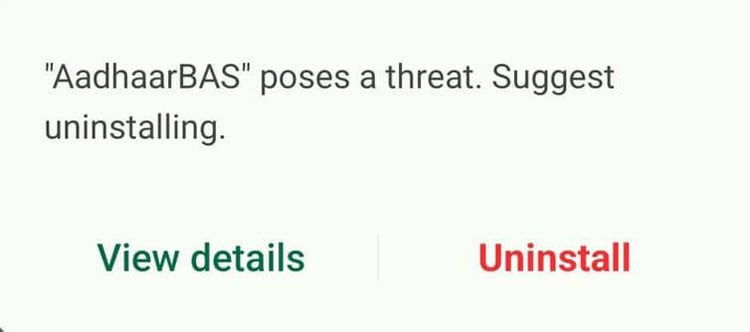

🔥A government APP SHOULDN’T TRIGGER A MALWARE SIREN. BUT THIS ONE JUST DID.
The government has officially rolled out the AadhaarBAS app — a mandatory tool for Aadhaar-based attendance across departments. But before employees could even start checking in, their mobile security tools had started checking out. Antivirus systems across devices are flagging AadhaarBAS as FileRepMalware, a high-risk Trojan-like threat capable of accessing sensitive data. And when a government-mandated app trips the same alarms as spyware, it’s not a glitch. It’s a crisis waiting to blow open.
💣 WHY A government APP BEING FLAGGED AS MALWARE IS AN EXPLOSIVE ISSUE
1️⃣ If a Govt-Mandated App Triggers Trojan Alerts, Trust Is Already Broken
This isn’t a random APK from a shady website — this is an app REQUIREMENT for employees.
If mobile security tools are detecting Trojan-like behaviour, something deeply wrong exists in the code, permissions, packaging, or distribution.
2️⃣ FileRepMalware Isn’t a Mild Flag — It’s a High-Risk, Data-Accessing Threat Tag
This classification typically signals:
Suspicious behaviour
Unknown publisher verification
Data-harvesting patterns
Potential remote-access capabilities
Risk of unauthorized data extraction
When does the same tag attach to a government app? Panic is justified.
3️⃣ Aadhaar Data + Malware Flags = The Perfect Nightmare Combination
We’re not talking about a wallpaper app or calculator.
This is an Aadhaar-linked attendance system.
It touches:
Biometric authentication
Identity records
Employee personal details
Location data
A Trojan alert here is not a “bug.” It’s a potential security breach with national-scale implications.
4️⃣ This Mirrors the Sanchar Saathi Shockwave — But Even Bigger
First, Sanchar Saathi had users panicking about permissions and privacy.
Now AadhaarBAS is being labelled malicious.
Two flagship digital-governance apps raising red flags in the same year?
That’s not a coincidence.
That’s a systemic failure in app vetting and cybersecurity compliance.
5️⃣ Employees Are Forced to Use It — Even When Security Tools Say “DANGER.”
Workers aren't choosing the app. They’re being mandated to install software that their devices classify as a Trojan.
That’s a digital-safety contradiction of the highest order.
No employee should have to override a malware warning to mark attendance.
6️⃣ The government MUST Issue an Immediate Clarification — Silence Is Not an Option
The moment a government app triggers malware warnings, authorities must:
Publish a security audit
Release technical validation
Confirm no harmful libraries or compromised certificates
Push a verified, signed update
Explain why antivirus systems are red-flagging it
Aadhaar is tied to every citizen’s identity.
Any hint of compromise — even a false alarm — demands a fast, transparent response.
7️⃣ Until Fixed, AadhaarBAS Risks Becoming the Biggest Digital-Governance Controversy of the Year
Because the question isn’t small:
Why is a government-issued Aadhaar app behaving in ways that mobile security tools interpret as malware?
Until the answer is delivered, the app remains under a cloud — and employees stay in unnecessary danger.
 click and follow Indiaherald WhatsApp channel