


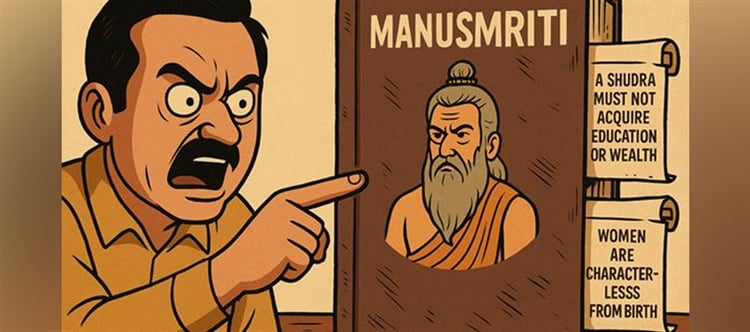

For centuries, a text was weaponized to decide who deserves dignity, who deserves education, who deserves freedom — and who deserves nothing. Manusmriti wasn’t a book; it was an instruction manual for inequality, a blueprint for locking entire communities and all women into permanent subordination. Even today, some people glorify it as “tradition,” ignoring the brutality it prescribes. So let’s tear away the sugarcoating and confront the raw, uncomfortable truth.
⚔️A Ruthless Breakdown of Manusmriti’s Oppressive Code
1. A Society Built on Walls, Not Bridges
Manusmriti didn’t describe society — it designed it like a prison.
Every human being was classified, restricted, and ranked before they were even born.
2. Education? Denied. Property? Denied. Humanity? Conditional.
For Shudras, Manusmriti didn’t merely limit opportunities — it outlawed ambition itself.
No learning. No wealth. No social equality.
It turned oppression into a rule and enforced inequality as “divine order.”
3. A Home? A House? A Life in Dignity? Forbidden.
Concrete houses? New clothes? Decent utensils?
The text literally policed the material comfort of an entire community — as if dignity were a crime.
4. “Sit as Equals”? Manusmriti Says No.
The book’s obsession with hierarchy was absolute.
It didn’t just create inequality — it ritualized it, sanctified it, and stamped it as “duty.”
5. The Most Chilling Section: A war on Women’s Freedom
According to Manusmriti, women were not individuals.
They were subjects, constantly monitored, never trusted, never independent.
“Characterless from birth,” it said — a line that exposes the paranoia at the heart of the text.
6. father → husband → Son: The Chain of Custody Model
At no stage of life did Manusmriti allow a woman autonomy.
Not as a girl.
Not as a wife.
Not as a mother.
Freedom was not a right — it was a threat to the system.
7. Control, Not Culture
The Manusmriti wasn’t about spirituality.
It was about preserving power for a few by institutionalizing submission for many.
8. The Most Dangerous Mindset: Calling Oppression “Sacred”
The problem isn’t merely what the book says —
it’s the mindset that defends it even today, hiding behind tradition while ignoring centuries of cruelty.
9. A Text That Failed — Because people Fought Back
Every reformer, every revolutionary, every social justice movement that challenged inequality was ultimately fighting Manusmriti’s worldview.
And that resistance is the reason india moved forward.
10. Today’s Question: Why Do Some Still Cling to It?
What kind of mindset reads such lines and still calls it holy?
What kind of worldview romanticizes control, inequality, and the policing of human dignity?
This isn’t about religion.
This is about refusing to accept a manual of oppression as a moral compass.
 click and follow Indiaherald WhatsApp channel