


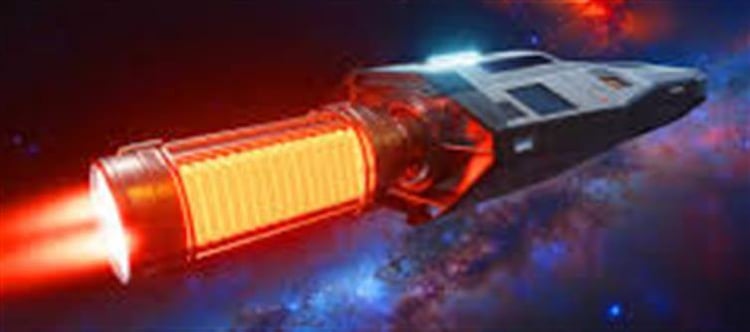

NASA is developing a new type of nuclear battery based on the radioactive isotope americium‑241 that — in theory — could power spacecraft for centuries. This marks a major leap beyond the current technology used in deep‑space missions and could support missions across generations.
🔋 What Is This Nuclear Battery and How Long Could It Last?
Unlike conventional spacecraft power systems that rely on solar panels or short‑life batteries, this new nuclear battery uses radioactive decay to generate electricity continuously. The key difference lies in the isotope used:
· Americium‑241 — being tested — has a half‑life of about 433 years, meaning it decays much more slowly than existing fuels.
· By comparison, current radioisotope systems typically use plutonium‑238, which has a half‑life of about 88 years.
If fully developed, a spacecraft powered with americium‑241 could still be generating useful electrical power centuries after launch — potentially outlasting entire space programs and supporting multi‑century missions.
🧠 How the Nuclear Battery Works
The concept isn’t about a battery in the consumer sense, but a radioisotope power source:
· Radioactive decay of the isotope naturally produces heat.
· That heat is converted into electricity using a device such as a free‑piston Stirling converter, a technology already tested to run for over a decade with minimal maintenance.
· There is no need for sunlight, recharging, or moving parts — the battery simply sits on the spacecraft and continuously generates electrical power.
This makes nuclear power systems ideal for missions far from the Sun, where solar panels become impractical due to low light intensity.
🌌 Why This Matters for Space Exploration
The extended lifespan of an americium‑based nuclear battery could enable missions that are currently unimaginable with today’s power systems:
· Interstellar precursor probes — spacecraft that travel beyond the solar system — would benefit from a power source that lasts centuries rather than decades.
· Outer solar system exploration — destinations like Uranus and Neptune — have long transit times and limited sunlight, making long‑lasting power essential for sustained scientific operations.
· Outer planetary moons and shadowed regions — places like the permanently shadowed regions of the moon or icy moons of Jupiter and Saturn could be explored with continuous power even in darkness.
In essence, missions could operate across centuries, potentially returning data over generational scales.
🔎 Comparing Old and New: Plutonium‑238 vs. Americium‑241
🔹 Plutonium‑238
· Current spacecraft power standard (e.g., for rovers and deep‑space missions).
· Half‑life: ~88 years.
· Power output declines over time, limiting mission duration.
🔸 Americium‑241
· New candidate under testing.
· Half‑life: ~433 years — nearly five times longer.
· Slower decay means sustained power for centuries, even as total output remains steady longer.
In practical terms, americium‑based systems won’t provide more power at the start than plutonium systems, but they retain usable energy over far longer periods — potentially making them the backbone of ultra‑long missions.
🧪 Status: Still in Testing and Development
According to nasa and partner institutions that include the University of Leicester and U.S. national laboratories, americium‑241 nuclear power systems are still in the experimental and testing phase. No mission has yet been approved to fly them.
Researchers are studying performance characteristics, electrical conversion methods, and safety considerations before finalising any mission design. If successful, this technology could be a stepping stone to a new class of deep‑space explorers carrying nuclear power that lasts centuries without refueling.
🚀 What It Could Mean for Future Missions
If the technology proves reliable, spacecraft could:
· Maintain instruments and communications far longer than current missions.
· Explore distant planets and moons without worrying about power depletion.
· Potentially enable interstellar probes that could send back data long after humans have moved on from Earth.
In short, a nuclear battery that lasts 433 years isn’t just a power upgrade — it could redefine the time horizon of space exploration.
Disclaimer:
The views and opinions expressed in this article are those of the author and do not necessarily reflect the official policy or position of any agency, organization, employer, or company. All information provided is for general informational purposes only. While every effort has been made to ensure accuracy, we make no representations or warranties of any kind, express or implied, about the completeness, reliability, or suitability of the information contained herein. Readers are advised to verify facts and seek professional advice where necessary. Any reliance placed on such information is strictly at the reader’s own risk.
 click and follow Indiaherald WhatsApp channel