




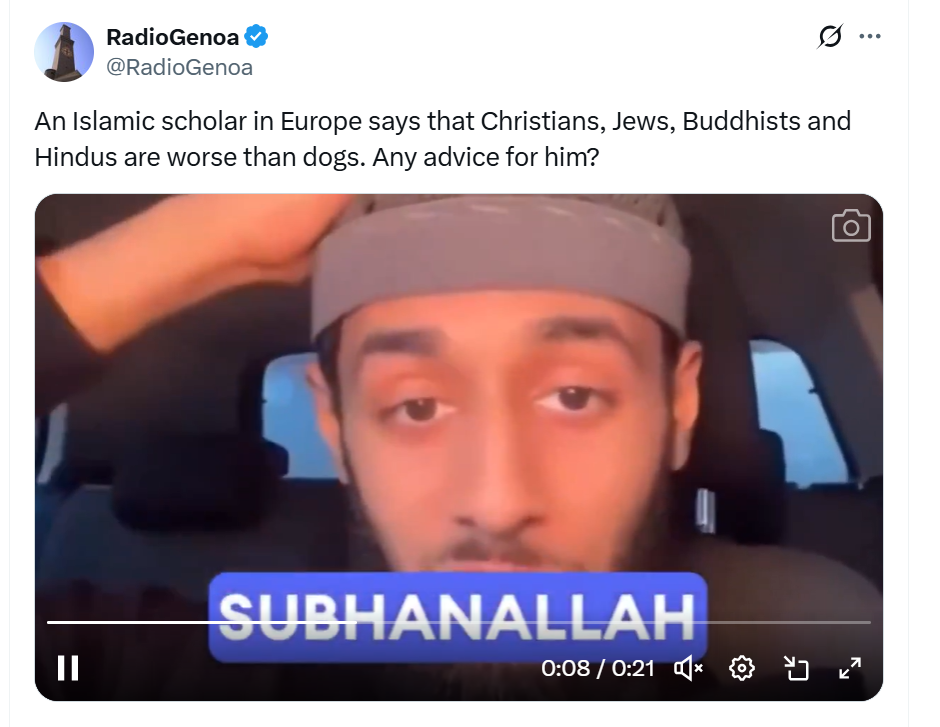
A video shared by RadioGenoa on social media has ignited a fierce debate after an individual, described as an Islamic scholar in Europe, made a provocative statement comparing non-Muslims to animals. The 20.57-second video, featuring a man speaking from inside a car, includes subtitles and text overlays that translate his remarks. He asserts that "men without the guidance of islam are worse than animals," suggesting that even dogs recognize a creator, whereas non-Muslims, referred to as "kuffar," do not have islam and are thus inferior.
The video's content, which includes phrases like "BUT PLEASE," "BUT ME AND THE KUFFAR," and "HAVE islam," is framed as a reminder to be grateful for islam, contrasting it with the perceived lack of moral and spiritual guidance among non-Muslims. The scholar's comments extend to a critique of non-Muslim practices, implying they are akin to animals and urging viewers to say "Alhamdulillah" (Praise be to God) for having Islam.
This statement has drawn significant backlash, with the post questioning what advice should be given to the scholar for such remarks. Responses range from condemnation of the comparison to animals to broader criticisms of Islamic rhetoric and its implications for interfaith relations in Europe. Some users suggest that such views reflect a deeper cultural and religious divide, while others call for a reevaluation of how Islamic teachings are interpreted and communicated in multicultural societies.
 The incident highlights ongoing tensions around religious tolerance, freedom of speech, and the integration of Islamic communities in Europe. It also touches on historical and contemporary issues of dhimmi status, where non-Muslims in Islamic societies were often subject to specific legal and social conditions. The debate extends to questions about the role of religious leaders in shaping public discourse and the potential for such statements to exacerbate social divisions.
The video's content, which includes phrases like "BUT PLEASE," "BUT ME AND THE KUFFAR," and "HAVE islam," is framed as a reminder to be grateful for islam, contrasting it with the perceived lack of moral and spiritual guidance among non-Muslims. The scholar's comments extend to a critique of non-Muslim practices, implying they are akin to animals and urging viewers to say "Alhamdulillah" (Praise be to God) for having Islam.
This statement has drawn significant backlash, with the post questioning what advice should be given to the scholar for such remarks. Responses range from condemnation of the comparison to animals to broader criticisms of Islamic rhetoric and its implications for interfaith relations in Europe. Some users suggest that such views reflect a deeper cultural and religious divide, while others call for a reevaluation of how Islamic teachings are interpreted and communicated in multicultural societies.
The incident highlights ongoing tensions around religious tolerance, freedom of speech, and the integration of Islamic communities in Europe. It also touches on historical and contemporary issues of dhimmi status, where non-Muslims in Islamic societies were often subject to specific legal and social conditions. The debate extends to questions about the role of religious leaders in shaping public discourse and the potential for such statements to exacerbate social divisions. click and follow Indiaherald WhatsApp channel